Our charter
The deeper framework,
stated plainly.
This is the institutional foundation underneath the Sunday morning — written for normal humans, not committees. No jargon, no fine print you need a dictionary for.
1 · Why we exist
Every generation inherits a world it didn’t create.
We inherit extraordinary knowledge, freedoms, traditions, and opportunities — and also division, distrust, isolation, misinformation, and unfinished problems. For a brief period, stewardship of that world becomes ours. Then we pass it on.
Everward begins with one question: what kind of human future is worth building? That immediately creates a second: what kind of people must we become to build it?
Our foundational belief is simple: human beings are capable of becoming better. Not perfect. Better — more truthful, responsible, compassionate, courageous, humble, reliable, connected, and willing to serve.
“Better” doesn’t mean more conservative or more progressive, more religious or less, wealthier or more educated. It means human qualities that stay meaningful across disagreement: truthfulness, integrity, responsibility, compassion, courage, wisdom, humility, service, fairness, curiosity, forgiveness, and respect for human dignity.
2 · How we learn
A rhythm, not a lecture.
Every Everward learning experience moves through the same cycle — and it’s circular, not linear, because reflection feeds the next round:
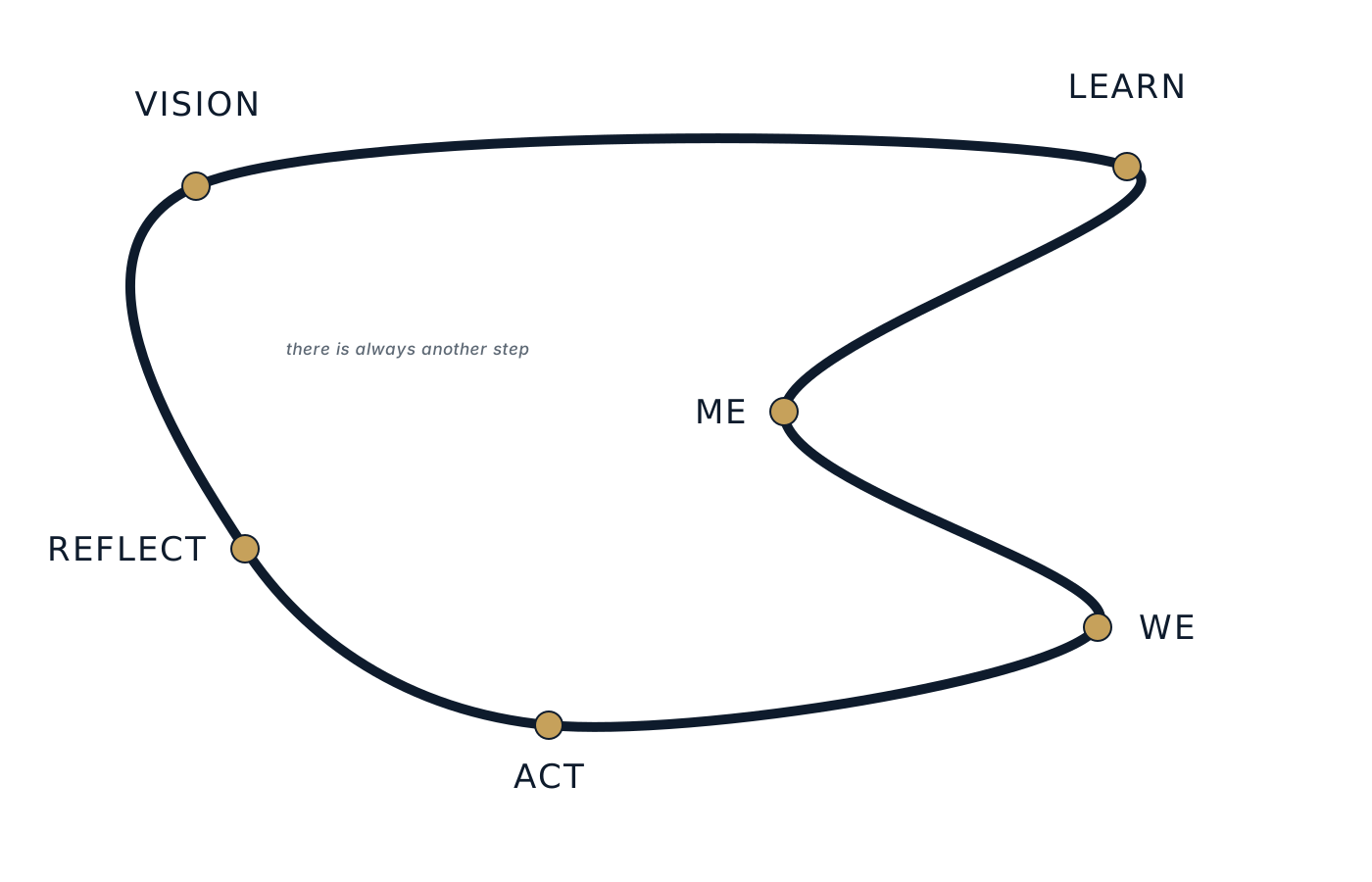
Vision — imagine a future worth moving toward. Begin with possibility, not complaint.
Learn — study what humanity already knows: philosophy, history, faith traditions, science, psychology, literature, lived experience.
Me — turn the standard inward first. Examine your own habits, integrity, and conduct before diagnosing anyone else.
We — move outward to relationships, community, and shared responsibility.
Act — translate insight into practice. One concrete step.
Reflect — ask what worked, what failed, and what should change. Then begin again.
3 · One
One does not mean same.
ONE is Everward’s philosophical symbol. Many lives. Many perspectives. One humanity. One shared future.
Human unity doesn’t require human uniformity. People can differ in religion, politics, culture, and philosophy while recognizing shared humanity, shared consequences, and a shared future.
One Table is where this becomes tangible: people gathering around food with relationship — not instruction — as the purpose. No one gets a better seat for wealth, title, education, or status.
4 · What we’re not
Boundaries matter.
Everward is not a political party, a campaign organization, a church, an anti-religious organization, a personality cult, a donor’s ideological vehicle, a debating society that only cares about winning, a self-help business dressed as community, or a social club disconnected from service.
It may remind you of philosophy groups, community centers, service organizations, or faith communities — but it isn’t reducible to any one of them.
5 · How we stay honest
Accountability is structural.
Good intentions don’t keep institutions honest — mechanisms do. Ours include:
Principles over methods. Our principles are durable; our methods — curriculum, format, the method’s sequence — are tools we change when evidence shows a better way. Improving the method is fidelity, not betrayal.
Intellectual freedom. Members may hold strong convictions and challenge the curriculum, the facilitators, the leadership, and the founder. Facilitators don’t provide approved answers.
The founder is subject to governance. The founder shapes early mission and culture but answers to governance, ethics, and financial controls like everyone else. No one is doctrinally infallible here.
Donor independence. Money doesn’t buy beliefs, curriculum, or outcomes. Gifts are disclosed; influence isn’t for sale.
Nonpartisan, always. Everward doesn’t endorse candidates, parties, or political teams — and that doesn’t change when it would be convenient.
We measure and we change. Everward studies whether what it does actually works — and changes its methods when the evidence shows a better way. Here’s how.
The truth about Everward matters more than the reputation of Everward.
That sentence governs this whole document — including the parts we haven’t gotten right yet.